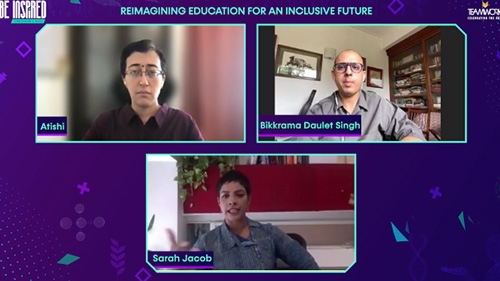
What is the real purpose of education? Is it imparting knowledge, increasing employability, or creating well-rounded and kinder adults? In an attempt to seek answers to these questions and find the silver lining amidst the pandemic, Ms. Atishi Marlena, Member of the Legislative Assembly of Delhi, and Mr. Bikkrama Daulat Singh, Co-Managing Director of Central Square Foundation, re-imagined an inclusive future of education in conversation with Ms. Sarah Jacob, NDTV's prime-time anchor and journalist. The speakers discussed if disruption can propel a positive change in the existing model of education and, if yes, what would be the direction of that change.
Acknowledging the pandemic as a watershed moment for the entire education system, Ms. Atishi voiced that the pandemic has only exposed the already existing fault-lines in our current education model. While the pandemic has jeopardised the progress made in the last three decades towards accessibility, it has further widened the lacuna by marrying accessibility with technology. For Atishi, equitable access to education is not synonymous with equitable access to technology as only 68% of students have a smartphone in Delhi which puts a double-edged question mark on the condition of students in remote areas.
The speakers underscored the need to fundamentally re-examine and reform the current curriculum that encourages rote-learning information that is easily available to us at the click of a button. Mr. Bikkrama steered the conversation with a rather thought-provoking question, “Are you in the prepare business or the repair business?” Agreeing with Atishi, he ratified the ground reality of education by quoting the data from the World Bank’s Learning Poverty Index from 2017, which indicated that India is suffering from 53-54% learning poverty where children at the age of ten lack foundational learning skills.
During the discussion, Mr. Bikkrama endorsed The National Education Policy that has identified this problem and prioritised foundational learning by designing holistic and meaningful programmes with dedicated schemes like Nipun Bharat. According to Mr. Bikkrama, the pandemic allowed us to experiment and reflect on our current situation to tackle the acute learning crisis exacerbated by the pandemic. Following this, Ms. Atishi ascertained the direction of the future of education in India as steadfastly advancing towards foundational learning, socio-emotional pedagogy and collaborative problem solving-with initiatives like the ‘Happiness’ curriculum introduced by the Delhi Government.
Mr. Bikkrama focused on the need to harness EdTech for delivering outcomes for not just India-1 but also India-2 and India-3 in the near future. He advocated for combination-based solutions to improve scalability with alternatives like Rocket Learning that is organisation-driven to build a learning system based on WhatsApp to reach out to students with access to smartphones and initiatives like Saarthi to supplement better classroom instruction by delivering offline worksheets to students who do not have access to technology to bridge the socio-economic gap.
Since the change in the education system needs to permeate vertically, Mr. Bikkrama foregrounded the need for reforms in teacher-training using EdTech to make the curriculum practice-driven rather than content-heavy. Ms. Sarah positively asserted, and the panelists agreed that technology is a great enabler of change and the future of education lies in a hybrid model of education fueled by innovation. The speakers highlighted the necessity of reform in assessment and testing that is vital for facilitating changes in teaching practices. Ms. Atishi brought attention to the efforts made by The Delhi Board of Secondary Education to make assessment a continuous stimulator of transformation in educational practices. On the other hand, Mr. Bikkrama remained optimistic that through The National Achievement Survey, a key-stage testing model could be brought in place that would prove to be a much better alternative to judge the quality of education based on competency-based tests than the annual assessment model currently in place.
Ms. Sarah Jacob wrapped up the discussion by re-emphasising the need for ameliorating the education system now more than ever. She said, “Nothing changes unless everything changes and everything has changed over the last couple of years.” As the discussion came to a halt, the silver lining amidst the dark clouds presented itself in an urgent need to revisit India's education system and radically change the fabric of learning to make it compatible with a tech-savvy future knocking the doors of present-day India.